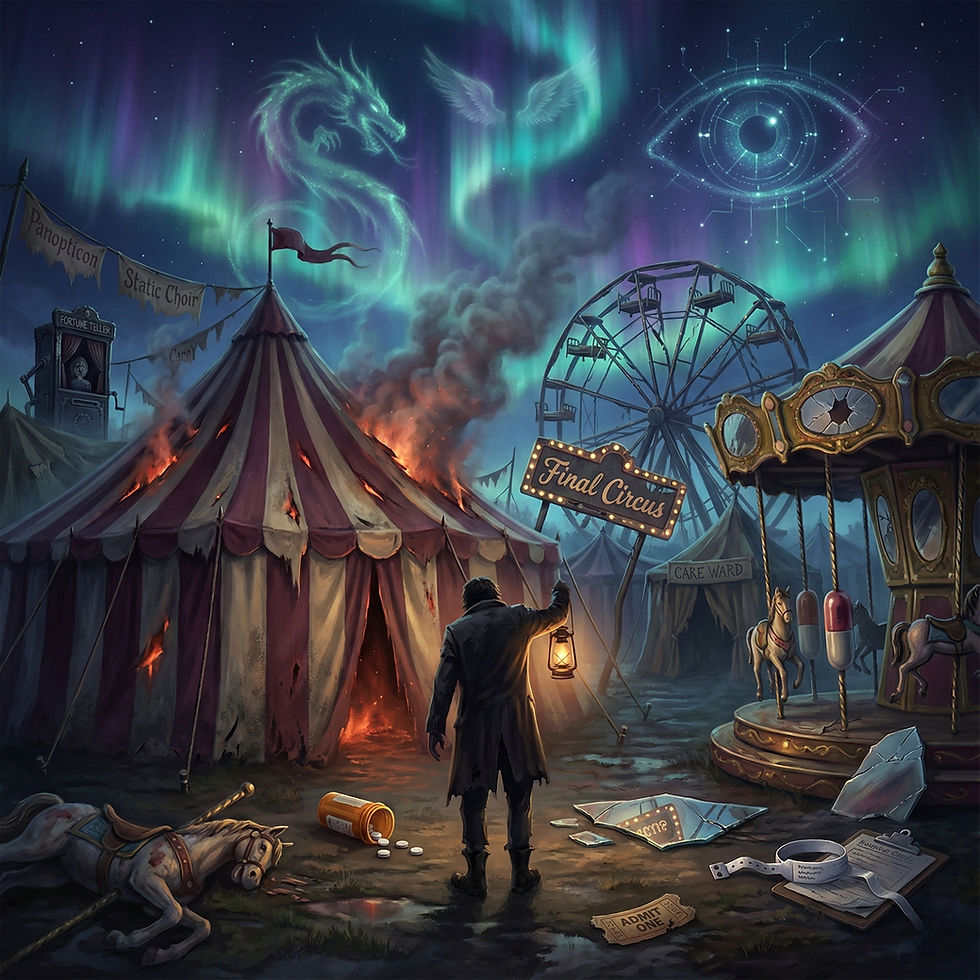
The Cabaret of Rewritten Poems — Tracklist & Arc


The Cabaret of Rewritten Poems was built deliberately as a staged experience rather than a loose collection of adaptations. Each piece is drawn from public-domain poetry, rewritten and set to music in a cabaret / circus framework, then ordered to form a clear emotional progression—from confinement, to reckoning, to release.
What follows is not a personal backstory, but a map of the show.
Act I — The Room and the Question
The album opens in enclosed spaces: rooms, chambers, halls of thought.
“Nevermore” (after The Raven) establishes the tone: obsession, unanswered questions, and the feeling of being trapped with language that refuses to comfort. The cabaret framing turns the poem into a ritual rather than a narrative, where repetition becomes the antagonist rather than the bird itself .
“Ozymandias (A Vaudeville Ruin)” follows by shifting scale outward. Where Nevermore is intimate and claustrophobic, Ozymandias is public and performative—power, legacy, and spectacle collapsing under their own exaggeration. The circus irony emphasizes how authority survives longest as theater, even when nothing remains .
“Alone” returns inward, reframing solitude not as tragedy, but as condition. This piece treats isolation as something elemental rather than dramatic—weather rather than wound—closing the first act with quiet inevitability instead of conflict .
Act II — Motion, Defiance, and Choice
The middle of the album introduces movement—sometimes reckless, sometimes joyful.
“Stand and Stare” interrupts the gravity of the opening with a question about pace. It challenges urgency itself, using music-hall brightness to ask whether speed has replaced meaning .
“In a Sieve” escalates that challenge into absurd defiance. Logic is abandoned entirely in favor of motion, nonsense, and collective joy. This track acts as the album’s centrifugal force—proof that survival doesn’t always come from sense-making .
“Alive, Alive” reframes action as responsibility rather than escape. Where In a Sieve celebrates joyful chaos, this piece grounds movement as intention—doing, choosing, and leaving traces that matter without sermonizing .
Act III — Persistence, Recognition, and Quiet Light
The final act softens without collapsing.
“Hope, With Feathers” presents endurance without bargaining. Hope is depicted not as optimism, but as a presence that persists regardless of circumstance—quiet, unpaid, and stubbornly alive .
“Before I Knew” shifts toward recognition and clarity. This is not a confession or a promise, but an acknowledgment of steady, non-performative connection—love without spectacle, demand, or rescue .
“Teach Me That Joy” lifts the album into motion again, but this time without desperation. Joy here is not naïve; it is earned curiosity, a willingness to learn delight without denying complexity .
“Dancing With Daffodils” slows everything down, allowing joy to arrive accidentally rather than be chased. It acts as a palate cleanser—reminding the listener that meaning sometimes enters quietly, without announcement .
“Outside the Lecture Hall” closes the album by stepping away from explanation altogether. After analysis, argument, spectacle, and song, the final gesture is simply presence—leaving the room, looking up, and letting wonder remain unsolved .
Curtain Call
Taken together, The Cabaret of Rewritten Poems moves from enclosure → confrontation → motion → persistence → release. It is not a diary, not a thesis, and not a metaphor for any specific life event. It is a staged conversation between old words and new sound, asking how poetry behaves when it’s given a body, a voice, and a spotlight.
The show ends not with answers, but with space.
And sometimes, that’s the point.
As I was finishing this project, I realized something quietly important: once words are released into the world, they don’t stop changing. Even when the lyrics stay the same, the room they’re sung in matters. Time matters. Sound matters. Perspective matters. I’ve been returning to earlier songs lately—not to rewrite them, but to hear what they become when placed under entirely different lights.
That process has grown into a separate album I’m currently completing, titled Encore in the Ashes. It’s a collection of older songs reimagined through a manic psychological horror-circus lens—fractured rhythms, industrial pressure, corrupted carnival textures, and looping structures that feel closer to panic than performance. Where much of my earlier work leaned toward cinematic, melodic, or theatrical storytelling, this project strips things down to instability and atmosphere. The lyrics remain unchanged, but the emotional weight shifts dramatically, shaped by repetition, distortion, and unease rather than narrative resolution. It isn’t a continuation of The Cabaret of Rewritten Poems, but it exists in conversation with it—another exploration of how meaning transforms when the stage, the sound, and the genre are fundamentally altered. More on that soon.