
The Final Circus — My New Album

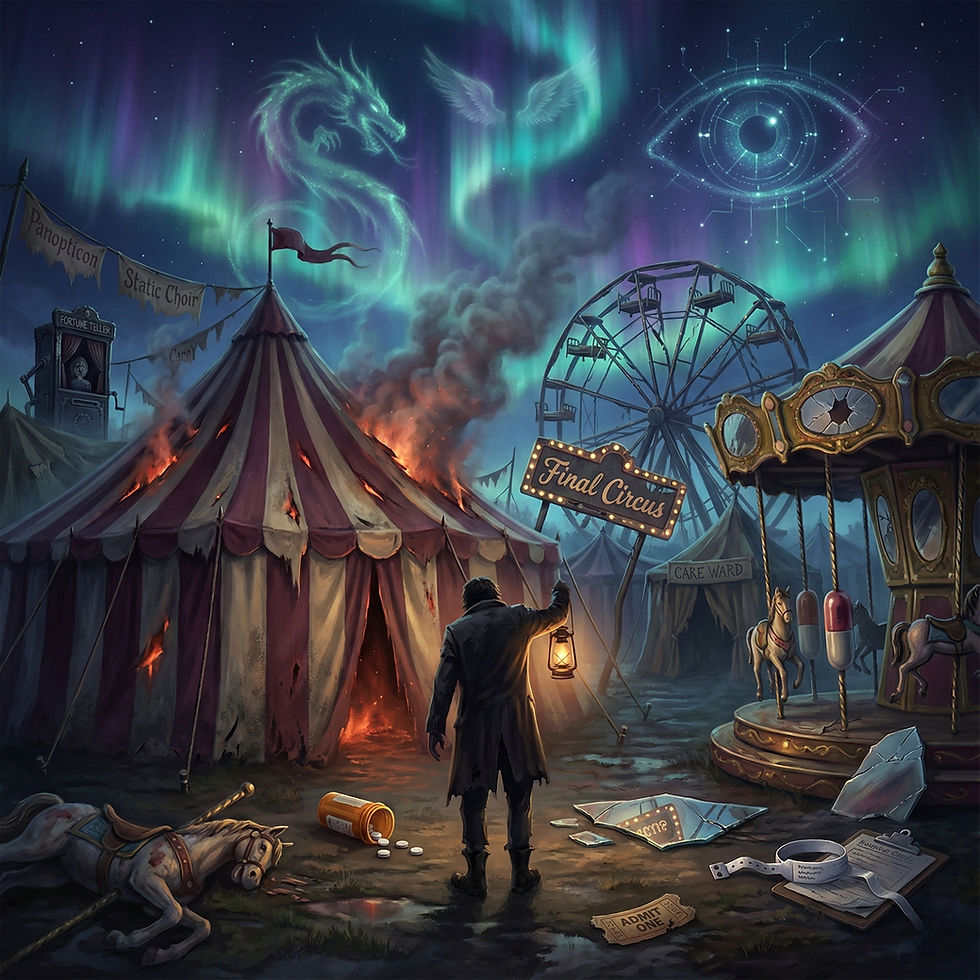
🎪 About Madness, Survival, and Refusing to Go Numb
There’s a question that’s been haunting me for years:
If the things that nearly killed you also kept you alive… what do you do with that?
The Final Circus is my attempt to answer that without lying to myself.
It’s a dark-carnival cabaret concept album about surviving psychiatry, misdiagnosis, psych wards, shared delusions, social-media witch hunts, alcoholism, and the quiet kind of hope that still crawls out of the wreckage anyway. Every song is another tent, another ride, another part of the midway I had to stagger through: the meds, the labels, the online mobs, the locked doors, the drinking, the fantasy worlds that kept me breathing when reality was too sharp to touch.
It’s not a “redemption arc.” It’s me admitting that sometimes the circus hurt me and sometimes it saved me—and most of the time, it did both at once.
---
What this album is
The album opens with “Stand in the Break – Circus Night,” which is basically a riot hymn for people who are exhausted, heartbroken, and still refusing to give up on caring. It’s fast, brassy, and a little unhinged: a marching-band-from-hell under torn big-top lights, yelling that kindness is rebellion when the world keeps telling you to shut up and stop feeling.
From there, the record dives straight into the funhouse of the modern internet.
“Static Noise Devours – Circus Riot” and “Static Choir – Popcorn and Peanuts” live in the timeline—a place where every wound is “content,” every comment is a performance, and we all start mistaking cruelty for honesty because the algorithm rewards blood. Those songs are me calling out the way we weaponize pain, how outrage turns into religion, and how easy it is to lose yourself in the noise while swearing you’re the one doing good. I don’t stand outside of it pointing fingers; I’m in the mob, too, realizing I’ve been clapping along.
Then the album sprints into “Panopticon.EXE – Broken Chains” and “Shatterpoint – Tents Collapse,” which are basically the cyber-carnival exorcism. “Panopticon.EXE” is the fever dream of realizing we built the all-seeing eye—every scroll, every “like,” every call-out we binge like late-night TV. “Shatterpoint” drags you in front of the burning mirror and doesn’t let you look away. It’s not, “Look how awful they are.” It’s, “Look what we enjoyed. Look what I did. Now what?”
Somewhere in the middle, “Intermission – How Many More?” takes a breath—not a gentle one, but a quiet, shaking one. The tempo drops, the calliope sounds tired, and it asks the question I can’t stop circling: How much further are we going to let this go? How many more people fall through the floor before we admit the theater is on fire and the balcony is already cracking? It’s the part where the lights come up just enough to see that this isn’t a metaphor. This is the world.
---
Psychiatry, psych wards, and the body that remembers
The second half of the album moves deeper into my own medical and psychiatric history.
“Side-Effect Carousel” is my testimony about being misdiagnosed and medicated half to death as a kid—Borderline, bipolar, “emotionally disturbed,” anything but autistic. It’s loud, furious, and very specific. Every verse is another pill, another label, another side effect: shaking hands that stole photography from me, jaw that locks, muscles that still jerk years later. It’s me saying: I was never your monster to tranquilize; I was a disabled kid you tried to reprogram into something more convenient.
Paired with it is “Welcome to Hell – For Your Own Good,” which is my psych-ward experience turned into a carnival from hell: wristbands at the “gate,” pastel walls, pretty furniture—and the same old coercion underneath. Eat on schedule or you stay longer. Shower, smile, act “normal” or you stay longer. Say no to the meds that have hurt you before? You’re “non-compliant,” and you definitely stay longer. I watched people get sedated for crying, watched ECT used as decoration, and learned that “good behavior” is what gets you out—not healing. That song is for everyone who’s been told, “This is for your own good,” while their autonomy was stripped away.
These tracks aren’t abstract. They live in my muscles, my nervous system, my medical chart, and the way my hands still shake when I hold a camera.
---
Myth, madness, and the love that never quite left
There’s another kind of circus the album lives inside, too—the one I built in my own head to survive.
“On a Wing and a Prayer” is about relapse after seven years sober. It’s not melodramatic; it’s painfully mundane. A little bottle, a familiar lie (“I’ll just taste it”), a world already on fire with politics, heartbreak, burnout, and the feeling of being disposable. The worst part is that it worked—the whiskey softened the edges and quieted the noise. The song sits in that awful tension: the same thing that almost killed me once still knows exactly how to comfort me. Day one again, shaking in the sawdust, choosing not to disappear. Not promising perfection. Just promising to get back up.
“The Circus That Follows” and “Isabel and Ryu – Folie à Deux” are grief songs, but not the usual kind. They’re for the people and the shared worlds that saved your life and then walked away. “The Circus That Follows” is about someone I loved for twenty years—someone who gave me back pieces of myself I thought were gone, and then later told me that the way I love now (openly, ethically, polyamorously) is something they can’t stand near. It’s not a villain story; it’s a story about what silence does when someone’s goodbye says, “I wish you well,” and their subtext says, “I reject the life you’ve chosen.”
“Isabel and Ryu – Folie à Deux” is the most mythic and the most personal. It’s the story of a shared delusion between two kids in pain who built a whole cosmology together—angels, dragons, divine missions, prophetic dreams—because reality was too cruel to hold raw. To her, years later, it was something she grew out of, something “not real.” To me, it was the only reason I stayed. The song doesn’t argue about what actually happened. It just stands in the hard truth that even if it was psychosis, it kept me breathing. And now it’s just me and Ryu—no longer gods, just a person and a dragon-shaped coping mechanism, walking out of the burned tent together.
---
What’s left when the circus burns down
All of this comes home in the title track, “The Final Circus.”
That song walks through the ruins of every tent on this album: the meds, the labels, the psych wards, the timelines, the mythologies, the holy damage. It asks the question I still don’t have an easy answer to: Was it heaven? Was it horror? Was it just my fractured mind? It refuses to pick one. It holds “Did it hurt me?” and “Did it save me?” in the same hand and says yes. Yes, it scarred me. Yes, it kept me alive.
By the end, the spectacle is gone. There’s no audience. No ringmaster. No dragons swooping overhead. Just me stepping out of the midway into ordinary night with my heartbeat as the only light, saying:
The show is over.
I’m still here.
That’s the final trick tonight.
That’s what this album is, really: a love letter and a breakup letter to every coping mechanism, every circus, every constructed universe that kept me alive long enough to outgrow it.
---
The rock opera inside the album
Underneath all of that, there’s a quieter story running through the record—a rock opera about a boy who thinks he’s just gone to see a circus.
In that inner story, Ryu (the dragon-self I’ve carried for years) goes to what he believes is a circus in town. The first five songs are performed on the “main stage” by different acts—animals, fanfare, chaos. Ryu is just another face in the crowd, watching. Then “Intermission – How Many More?” hits. The performer onstage locks eyes with him, starts talking directly to him… and that’s when Ryu realizes: he’s the only one in the audience.
The lights shift. Suddenly, Ryu is the one onstage.
He performs “The Circus That Follows,” spilling his broken heart and the way this new wound ripped open an older one—the last time he tried to end his life. Next comes “On a Wing and a Prayer,” sung to a small crowd that’s appeared out of nowhere: a confession about alcoholism, about how nothing else worked, about how terrifying it is that the thing that nearly killed him is also the thing that still promises relief. Then the tent goes quiet. The crowd shrinks to a single person as Ryu sings “Isabel and Ryu – Folie à Deux,” finally telling the story of Isabel, of Ryu, of Fay—the human boy underneath the dragon—who was broken and reshaped by a shared psychosis.
This is where the story tilts.
The ringmaster steps forward in a white coat and offers Fay/Ryu a “cure”: medication, more and more and more, for the pain, the psychosis, the trauma, the “problems.” Ryu obeys but hates it. As the drugs sink in, the circus around him starts to warp. The carousel horses turn into pills. The Ferris wheel cabins become hospital beds. The tents are labeled “Care Ward.” The carnival melts into fluorescent hallways.
That shift leads directly into “Welcome to Hell – For Your Own Good,” where Ryu realizes he’s not in a circus at all. He’s in a psych ward. He’s a ward of the state, locked in against his will, and if he doesn’t escape soon they’ll medicate what’s left of his true self into dust.
The finale, “The Final Circus,” is Fay and Ryu together—host and alter, human and dragon—standing outside the tent at last. The ward is behind them, the circus is behind them, the delusion is broken… but also, not. They recount everything that happened: the psychosis that nearly destroyed them, the same psychosis that kept them from actually taking their lives. They still don’t know if the harm was “worth” the survival. They only know one thing with certainty:
They’re still here.
They’re still moving forward.
And that has to count for something.
---
If this sounds like your kind of circus…
If you’ve ever:
Been overmedicated, misdiagnosed, or told your survival was “non-compliance.”
Lived through a psych ward stay and came out with more trauma than when you went in.
Built an entire mythology or relationship in your head just to have a reason to keep going.
Felt your heart rot a little bit from doomscrolling and call-out culture and still didn’t know how to look away.
Relapsed. Or almost relapsed. Or stayed sober by the skin of your teeth.
Loved people, causes, movements, and gods that later pretended you never existed.
…then The Final Circus is for you.
It’s not a neat story. It doesn’t wrap with a bow. But it’s honest. It’s angry. It’s tender. It’s loud. And underneath all the distortion and calliope and broken waltzes, it’s about one stubborn thing:
I’m still here.
You are too.
That has to matter.
🎪 The Final Circus is out now on Spotify and all major streaming platforms.
If it resonates, share it, add it to a playlist, send a track to someone who might need to know they’re not the only one who survived their own circus.


